


Causes and prevention of dysbiosis in broiler
Intestinal dysbiosis is an imbalance of the intestinal microbiota of multifactorial origin. The intestinal microbiota is the community of microorganisms that live naturally and balanced in the intestines of animals, and is composed of bacteria, archaea, fungi and protozoa, among others.

Intestinal dysbiosis is an imbalance of the intestinal microbiota of multifactorial origin. The intestinal microbiota is the community of microorganisms that live naturally and balanced in the intestines of animals, and is composed of bacteria, archaea, fungi and protozoa, among others.
In the case of broilers, dysbiosis can cause a series of problems such as diarrhoea, worsening growth parameters, increased mortality and greater susceptibility to different diseases.
Causes of dysbiosis
The causes of dysbiosis in broiler chickens are multiple, among which the following could be highlighted:
- Nutritional factors: Sudden changes in the diet, low quality of ingredients or the presence of toxins and/or mycotoxins can alter the balance of the intestinal microbiota. The presence of anti-nutritional factors is also an important aspect, since they make digestion difficult and favor the imbalance of the digestive flora.
- Environmental factors: Stress, excess density or poor hygiene can weaken the immune system of chickens, as well as the integrity of the intestinal mucosa, and make them more susceptible to dysbacteriosis.
- Infectious factors: Bacterial, fungal or protozoan infections can cause an imbalance of the microbiota.

Consequences of dysbiosis
As a consequence of dysbiosis, there will be settlements in the different sections of the digestive tract of those bacteria or microorganisms with pathogenic capacity, causing damage to it, and even being able to spread to the bloodstream causing a septicemic process.
At a zootechnical level, the parameters are affected, since the digestion and absorption capacity of nutrients is altered, and the feed conversion rate and weights deviate from the standards. Likewise, problems with watery feces or diarrhoea appear, which affect the quality of the litter, favour the volatilization of harmful compounds such as ammonia, and negatively affect animal welfare.
Prevention of dysbiosis
It is necessary to implement measures to avoid the factors that cause it. These measures include:
- To implement an appropriate feeding program: The diet must be balanced and contain all the nutrients necessary for the growth and development of chickens.
- To use high quality ingredients: they must be free of toxins and/or mycotoxins and microorganisms or implement programs to control them. We should avoid using ingredients or raw materials with high contents of anti-nutritional factors.
- To apply appropriate management measures: aimed at minimizing stress, excess density and improving hygiene.
However, it is common that, despite the implementation of these measures, cases of dysbiosis continue to be observed. One of the reasons is the high productive pressure of the birds in industrial farming conditions. This productive pressure generates excessive wastage of the digestive mucosa, especially the intestinal mucosa, facilitating the establishment of pathogens.
It is, therefore, necessary to strengthen the intestinal epithelium and the regeneration and functionality of its cells. There are natural solutions, such as pronutrients, that have been developed for this purpose. Specifically, intestinal conditioner pronutrients stimulate specific genes in enterocytes to improve their function and physiology. This translates into an optimization of the nutrient absorption surface, and a better condition of the villi, so that feeding efficiency is increased.
The mechanism of action of these pronutrients consists of inducing the reading of specific genes in the DNA, such as CD1E and RIMBP2, related to the functions of regeneration, nutrient absorption, and physiology of enterocytes.
Thanks to their mechanism of action based on the improvement of cellular physiology, they make the digestive mucosa more resistant to infections (newer cells, in better condition, which are more resistant) and prevent the presence of undigested feed in the intestine, which can act as a substrate for the growth of pathogens. For these reasons, pronutrients can replace antibiotic growth promoters and prevent the development of microbial resistances, since they do not act directly on microorganisms.
Efficacy of intestinal conditioner pronutrients in the prevention of dysbiosis
Multiple field trials have been carried out both in experimental and commercial farms around the world that have shown that intestinal conditioner pronutrients allow improving the use of the diet and, therefore, improving productive performance, even in favourable conditions for dysbiosis.
In a trial, carried out in Central America, the effect of intestinal conditioner pronutrients (PAI) was evaluated in broilers challenged at the digestive level by using a diet with a high content of anti-nutritional factors. Anti-nutritional factors generate an intestinal environment prone to dysbiosis, since they increase the viscosity of the digestive bolus, hinder digestion processes, and allow the substrate to be used by pathogens to multiply. The effectiveness of pronutrients was compared with the use of BMD combined with halquinol (non-antibiotic growth promoter).
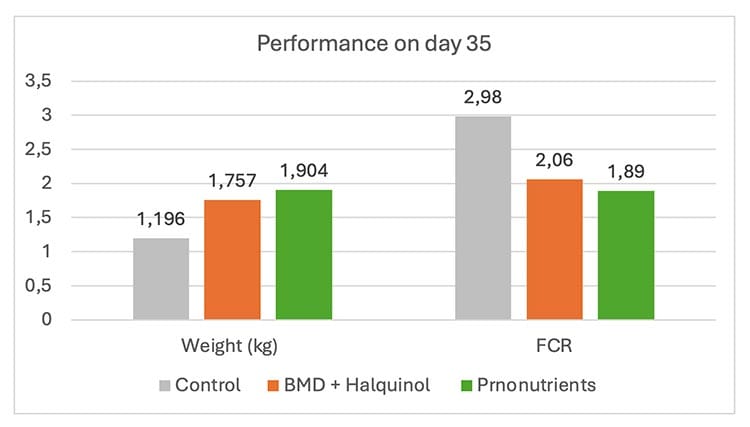
In the results, regarding weight, the batch with pronutrients obtained the best results, and finished the trial with 146.9 g/bird more than the BMD and halquinol batch, and 707.7 g/bird more than the control batch. Furthermore, pronutrients allowed a significant improvement in the feed conversion rate compared to both, the batch with promoters and the control batch, with 8.3% and 36.6% improvement, respectively.
These results indicate that for every million chickens receiving a diet with pronutrients instead of bacitracin and halquinol, 147 more tons of meat would be produced, and 324 tons of feed would be saved.
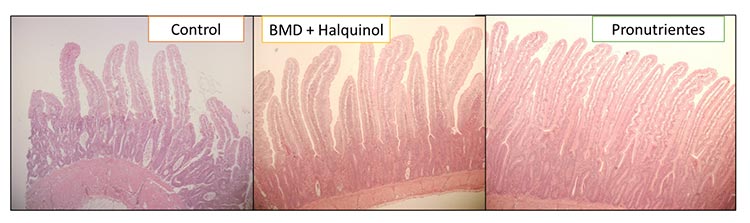
Part of this improvement is thanks to the effect on the regeneration of the intestinal mucosa achieved by pronutrients, thanks to which the villi appear in an optimal state for the absorption of nutrients, while the entry of pathogens is prevented.
Conclusions
Dysbiosis is an imbalance of the microorganisms that inhabit the digestive tract, having a multifactorial origin. Despite implementing programs aimed at mitigating the effect of the factors causing dysbiosis, it can still occur, due the productive pressure to which the birds’ intestine is subjected.
Several trials have shown that pronutrients physiologically activate the cells of the digestive epithelium, optimizing their functioning and improving the state of the digestive mucosa, so that the effect of the factors that cause dysbiosis is avoided, and they also help to achieve a greater weight with less feed consumption.
In trials on broiler chickens carried out in different parts of the world, an improvement in final weight of up to 370 grams per bird and a reduction in the feed conversion rate of up to almost 9% has been observed, with mortality also improved. These differences are noticeably greater the more challenging the farms are.
Additionally, this technology, developed and patented by Biovet S.A., allows to naturally replace antibiotic growth promoters, with the advantage that, due to their mechanism of action, these molecules of botanical origin do not cause the development of microbial resistances, they do not leave residues in animals, nor do they require a withdrawal period.


CATEGORIES
- Antibiotics
- Antioxidants
- Aquaculture
- Deodorizer
- Digestives
- Dissemination
- Enzymes
- Events
- Farm management
- Farm management
- Fats
- Feeding
- Flavorings
- Immunostimulants
- Microbiocide
- Mycotoxins
- Nutritionals
- Pathology
- Pharmacology
- Poultry Farming
- Preservatives
- Pronutrients
- Ruminants
- Swine
- Technology
It may interest you
Viral respiratory diseases in poultry farming: How to prevent them with vaccination systems
Reduction of gases in pig farms: the role of natural additives in emission mitigation
Poultry Nutrition: the role of feed supply systems and their impact on sustainable production
Enterococcus cecorum: A Growing Challenge in Broiler Production

Biosecurity in egg handling: What recommendations to consider?


Leave a Reply
You must be logged in to post a comment.