


Biosecurity in egg handling: What recommendations to consider?
Biosecurity in egg handling is a key issue to ensure that this food reaches the final consumer in optimal conditions.

Biosecurity in egg handling is a key issue to ensure that this food reaches the final consumer in optimal conditions.
Hens’ eggs are an important part of the global diet, providing protein and healthy fats at a low cost. At the same time, the poultry industry faces ongoing quality and safety challenges due to its susceptibility to contamination.
To ensure the safety of eggs from farm to table, there are a number of biosecurity recommendations for each stage, from production to distribution. In this context, innovative equipment and technologies play an important role in improving processes, making them more efficient, sustainable and in line with quality standards.
The egg as food: its role in the global diet
Eggs are considered a “superfood” because of their high protein content, which includes all essential amino acids. They also provide vitamins such as B12, riboflavin and vitamin D, which are important for immune function and bone health. They also contain polyunsaturated fatty acids, which are beneficial for cardiovascular health.
Globally, eggs are an affordable food, making them an essential part of a balanced diet, particularly in developing countries. This critical role in food security reinforces the need to ensure their safety, as an outbreak of contamination can have devastating public health and economic consequences.
In addition, egg production, whether on a family or industrial scale, generates millions of direct and indirect jobs in both developing and developed countries.

Egg physiology and vulnerability factors
The structure of the egg has been perfected over thousands of years of bird evolution to protect its contents, but it has limitations:
- The shell: Composed of calcium carbonate, it has microscopic pores that allow gas exchange but can also act as entry points for bacteria. The quality of the shell depends on factors such as the hen’s diet and health.
- Inner membranes: These additional layers provide a secondary barrier to microorganisms.
- Protein: Contains proteins with antimicrobial properties (such as lysozyme) that help fight infection.
- Egg yolk: Although encapsulated in the centre of the egg, it is rich in nutrients, making it an ideal target for bacteria such as Salmonella.
Understanding this structure helps to identify critical points where contamination is most likely to occur and to develop strategies to prevent it.
Why is biosecurity important when handling eggs?
Biosecurity encompasses all practices aimed at preventing, controlling and mitigating the risks of microbiological contamination of eggs. This focus is crucial because although eggs have natural protective mechanisms, exposure to external agents can compromise their quality.
For example, infections caused by bacteria such as Salmonella enteritidis can be transmitted both vertically (from hen to egg) and horizontally (environmental contamination). Adherence to biosecurity standards not only protects the health of consumers, but also enhances the reputation and competitiveness of producers in increasingly demanding international markets.
The poultry industry also faces many challenges in egg production, such as managing large bird populations, waste management and strict regulatory compliance. Key concerns include
- Disease control: Preventing infections in birds, such as avian influenza, is essential to prevent their spread to eggs.
- Environmental hygiene: Facilities must be cleaned regularly to minimise the presence of bacteria and fungi that could contaminate eggs.
- Quality of feed: Feed enriched with calcium and other nutrients improves both hen health and egg quality.
Adopting standards such as HACCP (Hazard Analysis and Critical Control Points) and GMP (Good Manufacturing Practices) ensures that each stage of production is designed to minimise the risk of contamination.

Egg handling best practices to ensure safety
Implementing best practices in egg handling not only protects egg quality, but also prevents economic losses. Specific recommendations include
- Immediate collection: Collect eggs at least twice a day to reduce exposure to contaminants.
- Proper grading: Separate dirty, broken or thin-shelled eggs as they are at higher risk of contamination.
- Storage: Use refrigeration to maintain a constant temperature (ideally between 4°C and 7°C) and a relative humidity of 75-80%. This will delay spoilage and reduce bacterial growth.
- Personal hygiene: Train workers in hand washing techniques, the use of gloves and the handling of specific utensils to reduce cross-contamination.
- Visual and tactile inspection: Inspect each egg for cracks, stains or residue on the shell.
- Avoid unnecessary washing: Wash eggs only when absolutely necessary to prevent microorganisms from entering through pores.
- Inventory rotation: Use a ‘first in, first out’ system to ensure fresher eggs are available for longer.

Innovation and sustainability in egg handling
Quality and sustainability are the cornerstones of today’s poultry industry. Giordano Global positions itself as a leader in advanced egg handling and transport solutions. Its technological systems not only ensure egg protection at every stage of the process, but also improve operational efficiency and reduce economic losses, setting global standards.
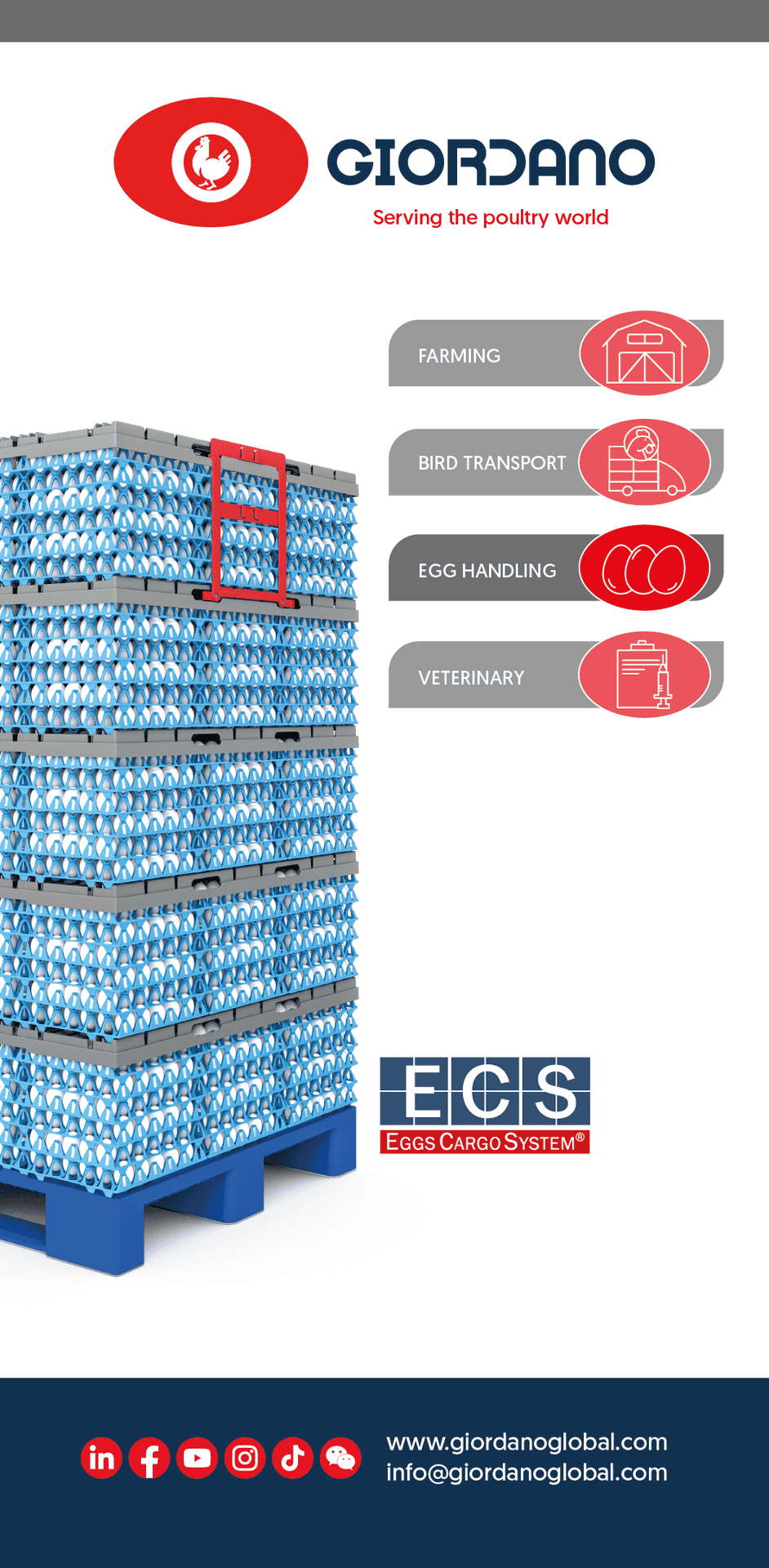
Introduced in 2000, Giordano’s EggsCargoSystem® (ECS) revolutionised egg handling with an integrated solution based on innovative, high quality plastic materials. The system consists of three main components
- Special plastic pallets: Designed to ensure even weight distribution and resistance during transport.
- Plastic dividers: Separate stacks of trays, facilitating robotic handling and stability during storage.
- Intelligent trays: Optimised design provides support and comfort for eggs, minimising cracking or breakage.
The EggsCargoSystem® (ECS) is available in three versions:
- Traditional: Ideal for chicken and hatching eggs.
- XL: Adapted for duck and turkey eggs, both for consumption and hatching.
- ECS MINI: A versatile option for chicken, turkey and duck eggs.
GIORDANO’s HatchCargoSystem® (HCS) is a pioneering solution designed specifically for the protection and transport of hatching eggs. This system has unique features:
- Stackable and linkable trays: Can hold up to 150 eggs per tray, eliminating the need for transport carts and optimizing space.
- Ventilated pallets: Allow ideal air circulation, essential for maintaining the necessary conditions during pre-incubation storage.
- Technology integration: Trays can include RFID chips or barcodes to facilitate tracking and logistics management.

Automation and Sustainability: The future of egg handling
Combining these trays with robotic systems allows for precise and efficient handling, reducing human intervention and minimizing egg exposure to contaminants.
GIORDANO trays are designed for flexibility, durability and adaptability. While they may look similar to other trays on the market, their design and materials set them apart:
- Premium material: Made from virgin high-density polyethylene (HDPE) with UV stabilization, which slows plastic aging and provides a 15-plus year lifespan.
- Optimized design: The “cups” where the eggs are placed are designed to provide adequate support and reduce the risk of damage, even during sudden movements.
- Adaptability to different sizes: GIORDANO offers trays for quail, duck, turkey and chicken eggs, ensuring specific solutions for every need.
The integration of automated technologies is a key component of GIORDANO’s systems. From robots that handle stacks of 180 eggs with millimeter precision to systems that interact with perfectly compatible components, these solutions ensure efficient and uninterrupted operations.
In addition, a focus on sustainability is evident in the choice of durable and reusable materials that significantly reduce environmental impact. This commitment benefits producers and meets the growing demands of environmentally conscious consumers.
You can also be interested in: How to improve poultry farm immunity with good equipment and vaccination practices?
Conclusions
Biosecurity is a priority in egg production and handling. Implementing best practices, complying with international standards, and using innovative technologies are essential to ensure a safe and sustainable supply.
Companies like GIORDANO are leading the transformation of the industry with equipment that combines efficiency, sustainability and quality. Solutions such as the EggsCargoSystem® and HatchCargoSystem® not only ensure optimal egg protection at every stage, but also represent a smart investment for the modern poultry industry.
Adopting these solutions not only protects public health, but also strengthens producers’ competitiveness in a global marketplace. With a comprehensive focus on biosecurity, this essential food can continue to be a reliable source of nutrition for future generations.


CATEGORIES
- Antibiotics
- Antioxidants
- Aquaculture
- Deodorizer
- Digestives
- Dissemination
- Enzymes
- Events
- Farm management
- Farm management
- Fats
- Feeding
- Flavorings
- Immunostimulants
- Microbiocide
- Mycotoxins
- Nutritionals
- Pathology
- Pharmacology
- Poultry Farming
- Preservatives
- Pronutrients
- Ruminants
- Swine
- Technology
It may interest you
Viral respiratory diseases in poultry farming: How to prevent them with vaccination systems
Reduction of gases in pig farms: the role of natural additives in emission mitigation
Poultry Nutrition: the role of feed supply systems and their impact on sustainable production
Enterococcus cecorum: A Growing Challenge in Broiler Production
Cochlosoma in turkeys
Leave a Reply
You must be logged in to post a comment.