


Importance of calcium in laying hens
Calcium is necessary for the formation and maintenance of bones, muscles and nerves, but it is also important for egg production since the eggshell is mainly composed of calcium.

Calcium is an essential mineral for various physiological processes to take place in poultry, and in laying hens it is especially important for their productive aptitude. Calcium is necessary for the formation and maintenance of bones, muscles and nerves, but it is also important for egg production since the eggshell is mainly composed of calcium.
Layers have high calcium needs, as they use this mineral to produce an eggshell strong enough to ensure its viability. One egg contains approximately 2 grams of calcium, so a laying hen needs to consume at least 4 grams of calcium per day to meet her needs and assimilate it properly.
If laying hens do not consume enough calcium, or if it is not absorbed properly in the intestine, several problems may occur, including:
- Skeletal weakness: bones become weak, and layers are more prone to bone fractures, such as the femur. In addition, the calcium reserves in the bones, which are necessary for shell formation during periods of high production or stress, also decrease.
- Rickets: it occurs in birds, mainly young, when not enough calcium is received. Deformed and poorly developed bones are observed.
- Alteration in egg production: laying hens that do not receive enough calcium can reduce their egg production or even stop laying. An increase in the percentage of broken eggs, and a decrease in the total egg weight, is also very frequent.
How to prevent calcium deficiency in laying hens
To ensure that laying hens receive sufficient calcium, it is important to provide them with a balanced diet that contains an adequate source of this mineral. In addition to providing a balanced diet, it is also important that hens have access to fresh, clean water at all times. Water is necessary for calcium absorption, as well as adequate levels of vitamin D.
On the other hand, the condition of the digestive mucus and the intestinal villi is fundamental, since it is in this organ that the absorption of the mineral will take place.
In poultry-breeding industry systems, as in layers, a series of phenomena occur that affect nutrition and mineral metabolism for different reasons. On one hand, there is a rapid transit due to the characteristics of the breeds used in commercial laying, which causes a loss of digestibility and alteration of the microbiota. This leads to poor nutrition and the appearance of dysbiosis, with proliferation of pathogens that can aggravate the problem by causing lesions in the digestive mucosa, altering the absorption of calcium and other minerals and nutrients.
Therefore, an adequate intestinal well-being must be guaranteed, and the mineral absorption at intestinal level must be promoted. For this purpose, Biovet S.A. has developed different technologies based on pronutrient conditioners of the mineral metabolism. This type of pronutrients stimulate specific genes in enterocytes, related to the specific absorption of minerals such as calcium and phosphorus. By doing so, a better utilization of the minerals supplemented in the diet is achieved.
Effectiveness of pronutrient conditioners of mineral metabolism
The effectiveness of this type of pronutrients has been tested in several experimental and commercial trials worldwide, where studies have been oriented to analyze their effect on parameters such as eggshell thickness, egg weight and eggshell breaking strength; parameters directly related to an adequate intestinal absorption of calcium.
In a recent trial carried out in Japan, one of the world’s leading egg producing countries, different production parameters were evaluated to see the effect of pronutrient conditioners of mineral metabolism, supplemented for 8 weeks, in comparison to a control batch.
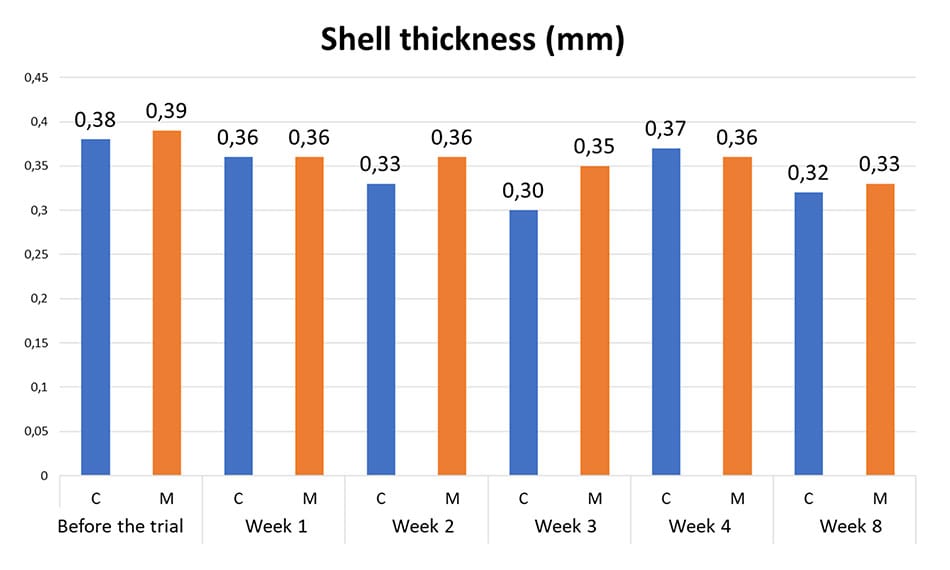
With respect to eggshell thickness, it was observed that in practically all the weeks of the trial, the hens in the pronutrient-supplemented group (M) obtained eggs with greater thickness, an indicative of a greater deposition of calcium due to a greater intestinal absorption of this mineral.
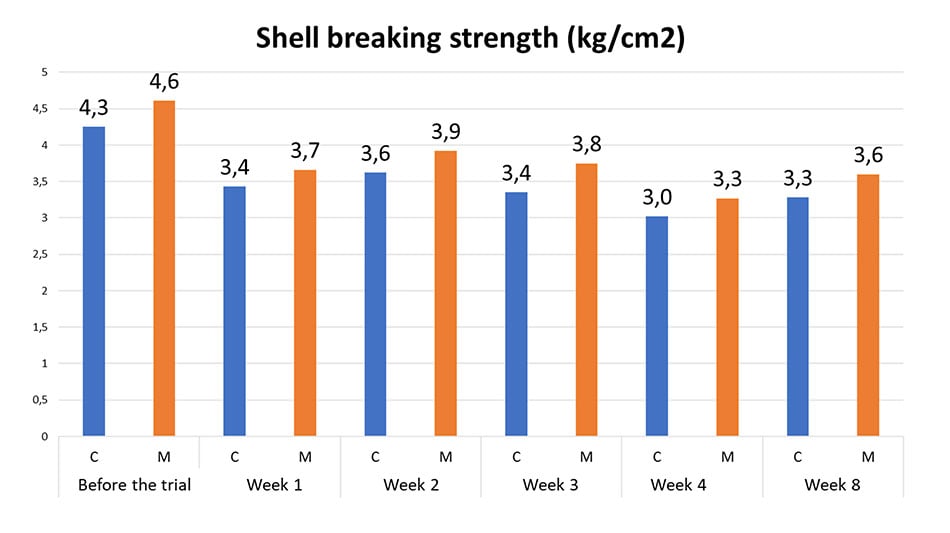
The greater shell thickness had a positive impact in the breaking strength, where the group supplemented with pronutrient conditioners of mineral metabolism had a greater resistance to breakage, indicative of a stronger shell due to greater calcium absorption and deposition.

Finally, egg weight was also higher in the pronutrient-supplemented group, not only because of higher calcium absorption and deposition, but also because pronutrients contribute to an improvement in intestinal well-being, which has a positive impact on nutritional processes.
Conclusions
The needs for calcium and other minerals in laying hens are very high in order to maintain the different physiological processes but, above all, for the shell formation process. Providing dietary levels of calcium in the diet is essential, but ensuring its level of absorption is key to optimizing the mineral metabolism and producing an adequate eggshell, while maintaining mineral reserves in the musculoskeletal system.
In this sense, pronutrient conditioners of mineral metabolism developed by Biovet S.A. have proven to be effective in promoting an increased calcium absorption in the intestine, with a positive impact on shell thickness, on breaking strength, or on egg weight, among other parameters.


CATEGORIES
- Antibiotics
- Antioxidants
- Aquaculture
- Deodorizer
- Digestives
- Dissemination
- Enzymes
- Events
- Farm management
- Farm management
- Fats
- Feeding
- Flavorings
- Immunostimulants
- Microbiocide
- Mycotoxins
- Nutritionals
- Pathology
- Pharmacology
- Poultry Farming
- Preservatives
- Pronutrients
- Ruminants
- Swine
- Technology
It may interest you

Viral respiratory diseases in poultry farming: How to prevent them with vaccination systems

Reduction of gases in pig farms: the role of natural additives in emission mitigation
Poultry Nutrition: the role of feed supply systems and their impact on sustainable production

Enterococcus cecorum: A Growing Challenge in Broiler Production

Biosecurity in egg handling: What recommendations to consider?


Leave a Reply
You must be logged in to post a comment.