


Avian intestinal protozooses
The use of pronutrients and additives in diets to strengthen immunity and intestinal health is the best prevention and treatment against...

In poultry, parasitic diseases have a significant impact on animal health and welfare on farms. The most important parasitic agents in relation to prevalence and economic losses in the sector are coccidia (Eimeria) and flagellates (Histomonas and Trichomonas). In fact, it is estimated that the costs associated with coccidia, including loss of productive performance, mortality, prophylaxis and treatment, may exceed 3 billion US dollars per year worldwide. However, there are also other protozoa: cryptosporidia, Cochlosoma anatis and amoebas. And also: Haemoproteus, leucocitozoos, Plasmodium spp., sarcocistos y Spironucleus meleagridis.
The consequences of a protozoan infestation are associated with a decrease in productivity, i.e. loss of daily weight gain and an increase in the feed conversion ratio. In addition, there is loss of pigmentation, dehydration and even death. Protozoan infestations mostly produce lesions in the gastrointestinal tract of fowls. Some lesions are pathognomonic, i.e. depending on the location and type of lesion, a diagnosis can be established (coccidiosis). In others, more specific techniques are required for diagnosis.
In general, the severity of the lesions depends on the exposure time and the number of oocysts ingested by the host. Protozoan oocysts are resistant in the environment, so disinfection and disinfestation of facilities and materials alone is not enough to prevent infestation. Therefore, nutrition is important to minimize the predisposing factors to protozoosis, associated with immunity and intestinal health of the bird.
Coccidiosis
Coccidiosis is the most common parasitic disease in the poultry industry and is mainly caused by protozoa of the genus Eimeria. The 7 universally known species are: Eimeria acervulina, E. brunetti, E. maxima, E. mitis, E. necatrix, E. tenella, E. praecox. All of them produce lesions in the small intestine except E. tenella which affects the cecum (see figure 1).
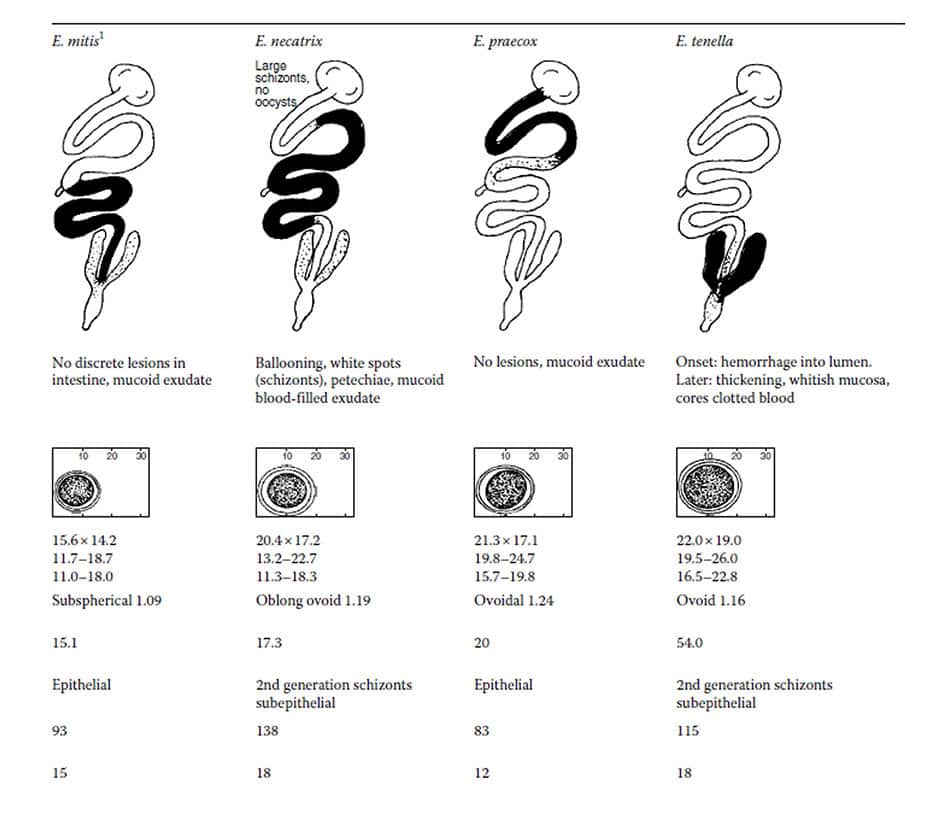

Tissue damage in the intestinal tract caused by coccidia infestation favours the colonisation of various bacteria such as Clostridium perfringens, which causes necrotic enteritis, or salmonellosis. Coccidiosis caused by E. tenella contribute to an aggravation of histomoniasis in chickens, as well as increasing the incidence of liver disease. In addition, the concomitance of immunosuppressive diseases such as Marek’s and Gumboro with coccidiosis can aggravate the infestation.
It is important to remark that there is no positive cross-immunity between different coccidian species. Therefore, it is possible that more than one outbreak of coccidiosis may occur in the same group with different species involved.
Flagellates
Histomoniasis, also known as blackhead disease, is caused by the protozoan Histomonas meleagridis and affects turkeys. There are two important differences respect to coccidia. First, the infestation requires an intermediate host (Heterakis gallinarium, fecal worm) but is not very common in turkeys, so transmission is usually accidental by the introduction of worm eggs from outside. Second, infestation affects the intestinal tract as well as the liver, producing widespread focal necrosis.
Trichomonas gallinae invade the upper digestive tract up to the proventriculus. The liver may also be affected, with focal necrotic lesions.
Cryptosporidia, Cochlosoma anatis y amoebas
Cryptosporiodiosis is caused by coccidia of the genus Cryptospordium, which live on the microvilli of the epithelial cells of the respiratory and gastrointestinal tracts of vertebrates, therefore, the lesions will be in both the respiratory and digestive systems. Cryptosporidium baileyi has as hosts the chicken, turkey and duck and affects the Bursa of Fabricius, cloaca and respiratory epithelium; C. meleagridis infests chicken and turkey and affects the small intestine.
Cochlosoma anatis primarily affects turkeys and ducks. The scientific literature shows disagreements regarding the pathogenicity and lesions caused by this protozoan because infestations are often concomitant with other pathogens.
Finally, infestation by amoebas of the genus Entamoeba has also been described in poultry, although it apparently does not produce pathogenicity.
In conclusion, the use of pronutrients and additives in diets to strengthen immunity and intestinal health is the best prevention and treatment against protozoa: immunostimulating pronutrients and metabolic antioxidants strengthen immunity; the use of biotin improves the epithelial quality of the intestine damaged by protozoa; intestinal conditioners and optimizers stimulate the regeneration of the digestive mucosa and ensure the correct functioning of the local immune system of the intestine.


CATEGORIES
- Antibiotics
- Antioxidants
- Aquaculture
- Deodorizer
- Digestives
- Dissemination
- Enzymes
- Events
- Farm management
- Farm management
- Fats
- Feeding
- Flavorings
- Immunostimulants
- Microbiocide
- Mycotoxins
- Nutritionals
- Pathology
- Pharmacology
- Poultry Farming
- Preservatives
- Pronutrients
- Ruminants
- Swine
- Technology
It may interest you
Viral respiratory diseases in poultry farming: How to prevent them with vaccination systems

Reduction of gases in pig farms: the role of natural additives in emission mitigation
Poultry Nutrition: the role of feed supply systems and their impact on sustainable production
Enterococcus cecorum: A Growing Challenge in Broiler Production

Biosecurity in egg handling: What recommendations to consider?


Leave a Reply
You must be logged in to post a comment.