


Prevalence and control of necrotic enteritis in South Asia
Necrotic enteritis is one of the most prevalent poultry diseases globally, as well as in the South Asian region. In this area, the prevalence varies, from 8% to more than 32% depending on the season and weather conditions, and it increases during the rainy seasons and in winter, when relative humidity is higher.

Prevalence and economic impact of necrotic enteritis in South Asia
Necrotic enteritis is one of the most prevalent poultry diseases globally, as well as in the South Asian region. In this area, the prevalence varies, from 8% to more than 32% depending on the season and weather conditions, and it increases during the rainy seasons and in winter, when relative humidity is higher.
However, in addition to its high prevalence, the most alarming aspect for the poultry industry is the great economic impact caused by this disease. Mortality can exceed 30% during the outbreaks, and the productive parameters are markedly affected, mainly the weight and the feed conversion rate, which are worsened by around 8% and 10% respectively.
Several types of antibiotics have been used for the prevention and treatment of this disease, such as AGP as preventative, or penicillin as treatment. However, new global legislative trends and, mainly, the emergence of microbial resistance, made these methods less effective, and new natural alternatives for prevention and treatment have become necessary.
Necrotic enteritis: characteristics and predisposing factors
Necrotic enteritis is an acute infection caused by Clostridium perfringens and its capacity to produce toxins, mainly types A and C. Clostridium perfringens is an obligate anaerobe gram-positive bacterium that is part of the intestinal microbiota. Outbreaks of necrotic enteritis appear in most cases due to an excessive proliferation of this microorganism.
This disease appears mainly in chickens between 2 and 5 weeks of age, but it can also affect hens at the beginning of the laying phase or near the laying peak. In both cases, dehydrated birds and diarrhoea in different degrees are observed, but the main consequence is a markedly increase in mortality that, in severe cases, can reach 30%.
At necropsy, many necrotic foci distributed in the mucosa of the small intestine can be observed from both the outside and the lumen of the intestine, where there is loss of intestinal villi.

Furthermore, there are lesions in gizzard, specifically between muscular and glandular stomach, where anaerobic conditions favour the growth of Clostridium. Finally, it can also affect the liver, when the toxins produced by Clostridium perfringens reach this organ.

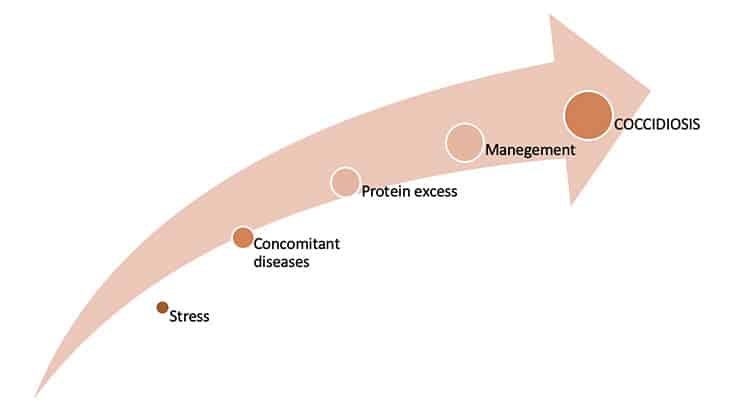
The control of this disease is especially difficult because there are many predisposing factors that lead to the proliferation of Clostridium perfringens and the appearance of outbreaks. Coccidiosis is one of the most important predisposing factors. The different species of Eimeria, mainly E. maxima, cause lesions in the intestinal mucosa that facilitate the adhesion and multiplication of Clostridium perfringens. Therefore, a high percentage of necrotic enteritis cases are associated with coccidiosis, both clinical and subclinical. However, there are other predisposing factors that must be under control to avoid outbreaks.
Cimenol ring, natural technology for the prevention of necrotic enteritis
As previously described, Clostridium perfringens is part of birds’ microbiota, and several predisposing factors usually lead to its excessive proliferation causing outbreaks of necrotic enteritis. However, Clostridium can come from feed, too, where it forms heat-resistant spores. Therefore, it is necessary to control this microorganism both in the intestine itself and the feed. For this, it is necessary to reduce the concentration of Clostridium above pathogenic levels.
Biovet S.A. has developed a natural antimicrobial technology, capable of controlling pathogenic microorganisms, such as Clostridium perfringens, that is effective for the prevention and treatment of necrotic enteritis.
This natural technology is based on the combination of two natural active ingredients, cimenol ring and citric acid, which act synergistically. On one hand, cimenol ring breaks the membrane of the pathogenic microorganisms, destabilizing the lipid bilayer from inside the bacteria. On the other hand, citric acid creates pores in the membranes of the pathogens and facilitates the entry of the cimenol ring into them.
The antimicrobial activity of these combined active ingredients was evaluated both in vivo and in vitro against several pathogenic microorganisms. The specific antimicrobial efficacy against Clostridium perfringens has been studied under multiple conditions following the scientific method.
Alquermold Natural is the product developed by Biovet containing this natural technology. Recently, its effectiveness was evaluated for the prevention and treatment of necrotic enteritis in South Asian conditions, specifically in India. For this, a trial was conducted at Chennai University, and the birds were artificially challenged with Clostridium perfringens in order to cause a necrotic enteritis outbreak. Alquermold Natural (AMN) was evaluated as preventative, continuously administered in feed, and as treatment, administered in drinking water when the outbreak appeared.
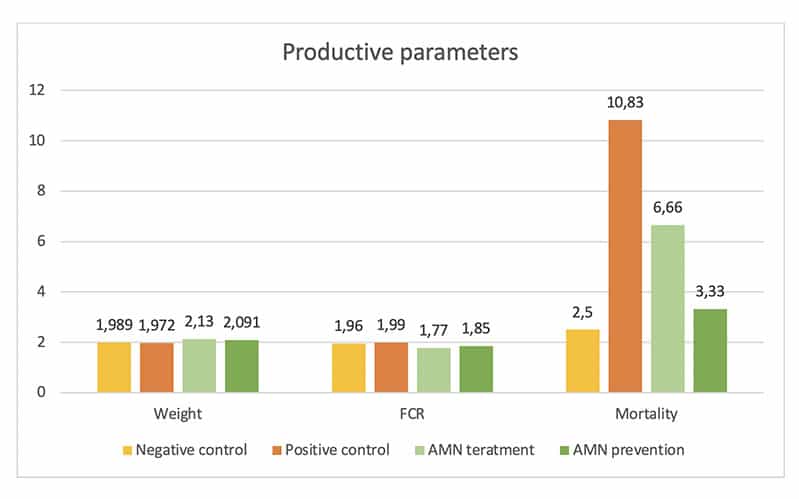
The results show that, in both batches where Alquermold Natural was administered whether as a preventive in feed and as treatment in drinking water, an improvement was obtained compared to the control groups. Regarding weight, Alquermold Natural compared to the positive control obtained an improvement of around 6% as a preventive, and of around 8% as treatment. Besides, Alquermold Natural as preventive improved feed conversion rate (FCR) by 7%, and by 11% as treatment. It should be noted that both parameters were also better than the negative control with non-infected birds. The reason is that the product helps to balance the intestinal flora and indirectly improves the productive parameters, even in absence of artificial infection.
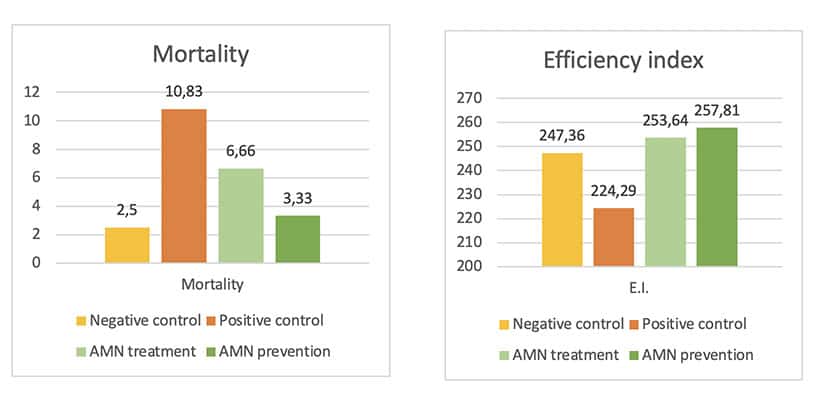
Regarding mortality, using Alquermold Natural as a preventive, a reduction of 69.25% was obtained, and 38.5% reduction when used as treatment.
All the parameters showed a greater efficiency (better efficiency index) in the farm when Alquermold Natural was used, whether as a preventive or treatment, obtaining results even better than those of the negative control, where birds were not artificially infected with Clostridium perfringens.
Conclusions
In South Asia there is a high necrotic enteritis prevalence that negatively affects the economy of the farms because of high mortality and worsened performance that this disease produces. Therefore, it is necessary to implement adequate prevention and treatment programs. Antibiotic-based programs have traditionally been used, but their effectiveness nowadays is much lower because of bacterial resistance. Moreover, antibiotics have been restricted or banned in many countries worldwide. Biovet S.A. has developed a natural technology with a high microbicidal effect against Clostridium perfringens, that can be used for both, necrotic enteritis prevention and treatment. This technology is marketed as Alquermold Natural, and its effectiveness has been widely proven. The latest trial was carried out at a University in India and a marked positive effect was observed with the use of the product. Thanks to the use of Alquermold Natural, an improvement in weight around 6% to 8% was obtained, and in feed conversion rate around 7% to 11%. In addition, mortality was reduced up to 69% when the product was used as a preventive, achieving a 25 points better efficiency index than the positive control. Furthermore, Alquermold Natural improves the productive parameters also compared to the non-infected group, because the product also controls other intestinal pathogens. Alquermold Natural has many advantages compared to traditional antibiotics for necrotic enteritis prevention since it is totally natural, does not leave residues in meat or eggs, does not generate microbial resistance, and does not require a withdrawal period.
Bibliography
- Balachandran, P., Srinivasan, P. “Prevalence and predisposing factors in spontaneous cases of necrotic enteritis in cage reared commercial layer chicken”
- Rakha, N., Datta, S. EPIDEMIOLOGY OF ENTERITIS IN BROILER CHICKENS IN THE STATE OF HARYANA AND ITS ASSOCIATION WITH DIFFERENT METEOROLOGICAL PARAMETERS
- Churchil, R., Kanagaraju, P., Masilamoni, S., IUCRP Research Project on Validating the Efficacy of Alquermold Natural® for Intestinal Health in a Necrotic Enteritis Model as a Treatment in Drinking Water and as a Preventative in Feed


CATEGORIES
- Antibiotics
- Antioxidants
- Aquaculture
- Deodorizer
- Digestives
- Dissemination
- Enzymes
- Events
- Farm management
- Farm management
- Fats
- Feeding
- Flavorings
- Immunostimulants
- Microbiocide
- Mycotoxins
- Nutritionals
- Pathology
- Pharmacology
- Poultry Farming
- Preservatives
- Pronutrients
- Ruminants
- Swine
- Technology
It may interest you
Viral respiratory diseases in poultry farming: How to prevent them with vaccination systems
Reduction of gases in pig farms: the role of natural additives in emission mitigation
Poultry Nutrition: the role of feed supply systems and their impact on sustainable production
Enterococcus cecorum: A Growing Challenge in Broiler Production

Biosecurity in egg handling: What recommendations to consider?


Leave a Reply
You must be logged in to post a comment.