


Natural solution to increased antibiotic resistance in Africa and the Middle East
Intestinal conditioner pronutrients are a natural alternative to ensure animal productivity. Since they are molecules of botanical origin that act at the physiological level and not on microorganisms, they do not generate resistances, leave no residue in animals and do not have withdrawal period.
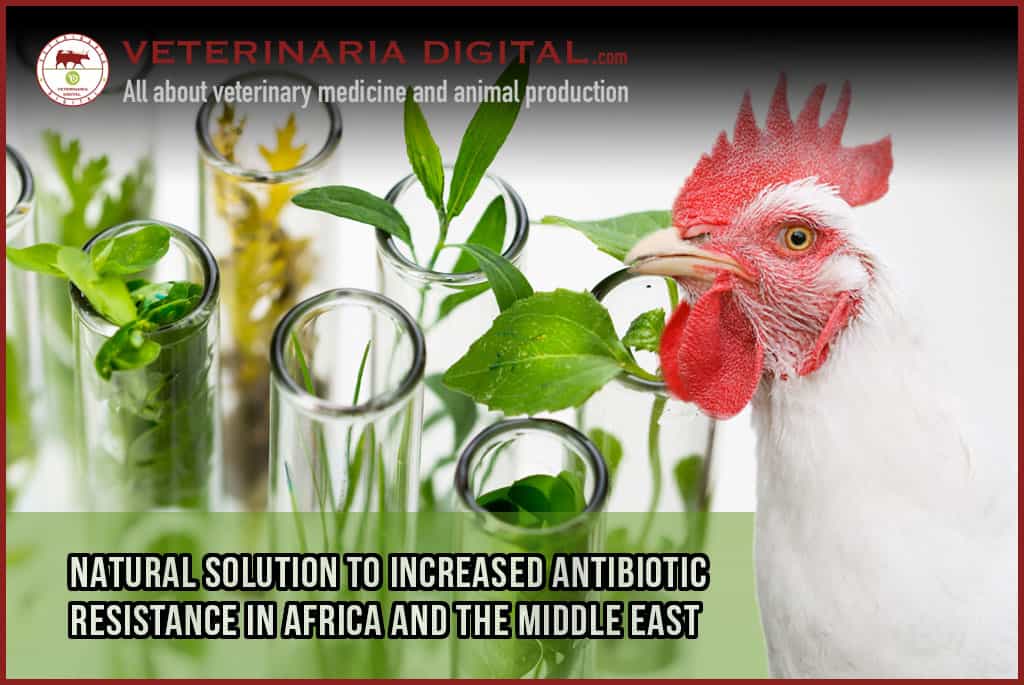
The emergence of antibiotic resistance is an increasingly important problem in Africa and the Middle East, due to the use of growth-promoting antibiotics in animal feed.
Intestinal conditioner pronutrients are a natural alternative to ensure animal productivity. Since they are molecules of botanical origin that act at the physiological level and not on microorganisms, they do not generate resistances, leave no residue in animals and do not have withdrawal period.
Increased antibiotic resistance in Africa and the Middle East
Bacterial resistance to antibiotics is caused by mutations of these that prevent the antibiotic from having its effect, either because they are inactivated by various enzymes produced by bacteria, by modifications that prevent the arrival of the antibiotic to the target point or by alterations by the bacteria of the target point of the antibiotic.
These resistances are one of the biggest public health problems nowadays. It has been estimated that around 25,000 deaths a year occur in the European Union (EU) due to multi-resistant bacteria, which cost 1.5 trillion euros per year.
In both Africa and the Middle East, the emergence of antibiotic resistance has increased significantly in recent years. Antibiotic resistance has been reported in many African countries such as Kenya, Nigeria, Ethiopia, Ghana, South Africa and Tanzania. In these countries, strains resistant to different pathogens such as E. coli, Mycobacterium tuberculosis, Staphyloccocus aureus or Salmonella spp. that put at risk the public health.
In the case of the Middle East, there has been a marked increase in the emergence of antibiotic resistance in countries such as Egypt, Sudan and Saudi Arabia. In the case of Egypt, a high prevalence of Clostridium perfringens strains resistant to major antibiotics has recently been isolated.
The use of growth-promoting antibiotics (PGAs) is one of the main causes that favor the emergence of antibiotic resistance. PGAs act directly on pathogenic bacteria, improving the balance of digestive flora. However, since they are administered at subtherapeutic doses,they are not alwayseffective for the control of pathogenic bacteria. At the same time, continued exposure of bacteria to subtherapeutic doses of antibiotics promotes resistance.
In the case of poultry, the most commonly used antibiotics as PGAs in these countries are macrolides and tetracyclines. An example of how the use of PGA is widely implemented in Africa is a study conducted in Uganda (2017), which found that 97% of producers used antibiotics as growth promoters. In addition, it revealed that most producers had little knowledge about the use of antibiotics.
In a large number of countries worldwide, such as the United States, the EU or China, there are specific limitations related to the use of APC in animal production, with the aim of reducing the emergence of resistances. In the case of Africa and the Middle East, only South Africa has legislation in this regard, in the rest of the countries the use of APC is poorly regulated.
Todo says that in the coming years the use of APC will be increasingly limited in both Africa and the Middle East.
Natural alternative – intestinal conditioning pronutrients
From Biovet S.A. by observing the problems that lead, on the one hand, to obtaining insufficient productive yields and, on the other hand, to the generation of bacterial resistances with very negative impact in both animal industry and public health, we have concluded over the years in the need to develop effective alternatives to achieve good yields without the problems presented by antibiotics. This has developed a technology based on intestinal conditioning pronutrients as an effective alternative to growth-promoting antibiotics.
Pronutrients are active molecules of botanical origin, derived from shikimic acid and acting at the metagenetic level,increasing the expression of specific genes, which ultimately results in an increase in thesynthesis of functional proteins. The administration of pronutrients strengthens fortalece and maintains animal health by improving production parameters.
GPAs act directly on microorganisms, but since they are administered at subtherapeutic doses, they are not always able to eliminate pathogenic microorganisms. Unlike these, pronutrients act at the physiological level, improving the health and productive state of the animal.

Illustration 1. Effect of intestinal conditioning pronutrients on the intestinal mucosa
Intestinal conditioning pronutrients have as a target cell the enterocytes, that is, they work improving the regeneration and functioning of the enterocytes. The use of these pronutrients improves intestinal integrity, increasing the absorption of nutrients (vitamins, amino acids, etc.) and limits the entry of pathogens into the animal, as it improves tight junctions between enterocytes.tight ) entre los enterocitos.
Rfield sultings with intestinal conditioning pronutrients vs. AGPs
Numerous studies have been conducted showing that the use of intestinal conditioning pronutrients replaces growth-promoting antibiotics. The addition of these active molecules allows to improve the productive parameters (weight, IC, etc.) and at the same time reduce mortality (table 1).
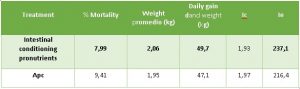
Illustration 2. Trial carried out with 40,000 animals, divided into two experimental groups, one with growth-promoting antibiotics (APC) and a second group with intestinal conditioning pronutrients. The mortality rate, average weight (kg), daily weight gain (kg), conversion rate (IC) and efficiency index (IE) were evaluated.
By extrapolating the results shown in Table 1, to one million broilers,the use of intestinal conditioning pronutrients would allow to obtain 100 tonnes more meat and reduce feed consumption by 20.6 tonnes,which is a clear positive effect on the economicbalance sheet.
At the same time, it is important to note that intestinal conditioning pronutrients are botanical molecules that act on enterocytes, not bacteria, so they do not generate resistances,unlikeantibiotics. Inaddition, they leave no residue on animals and lack a period of suppression..
Conclusion: pronutrients, the natural solution to ensure animal productivity
Theuse of Alquernat Nebsui improves the health and integrity of the intestinal epithelium, which is reflected in the improvement of productive parameters. The use of Alquernat Nebsui allows to improve the final weight of the animals by 5,,5% and at the same time reduce the conversion rate by 2%,since the animals make better use of the feed supplied.
At thesame time, improving digestive health is directly related to lower bird mortality. The use of Alquernat Nebsui reduces mortality by up to 18%.
We can therefore conclude that the use of Alquernat Nebsui,a natural product based on intestinal conditioning pronutrients, is an effective tool to ensure animal productivity..
Intestinal conditioner pronutrients are marketed under the name Alquernat Nebsui from Biovet


CATEGORIES
- Antibiotics
- Antioxidants
- Aquaculture
- Deodorizer
- Digestives
- Dissemination
- Enzymes
- Events
- Farm management
- Farm management
- Fats
- Feeding
- Flavorings
- Immunostimulants
- Microbiocide
- Mycotoxins
- Nutritionals
- Pathology
- Pharmacology
- Poultry Farming
- Preservatives
- Pronutrients
- Ruminants
- Swine
- Technology
It may interest you

Viral respiratory diseases in poultry farming: How to prevent them with vaccination systems
Reduction of gases in pig farms: the role of natural additives in emission mitigation
Poultry Nutrition: the role of feed supply systems and their impact on sustainable production
Enterococcus cecorum: A Growing Challenge in Broiler Production

Biosecurity in egg handling: What recommendations to consider?


Leave a Reply
You must be logged in to post a comment.