


Selective effect of cimenol ring on the gut microflora: sensitivity of pathogenic and beneficial bacteria
Cimenol ring is a botanical molecule that acts as a broad-spectrum natural microbicide effective against pathogenic microorganisms.

The importance of a balanced microflora
The balance of the gut microflora is essential to prevent digestive problems and achieve good performance results in animal husbandry. This balance should be based on the maintenance of the beneficial gut flora, with bacteria such as Lactobacillus, and the control of pathogenic microorganisms like E. coli or Clostridium perfringens.
Cimenol ring with citric acid
Cimenol ring is a botanical molecule that acts as a broad-spectrum natural microbicide effective against pathogenic microorganisms. It acts synergistically with citric acid to eliminate the microorganisms in the feed and the digestive tract to maintain the balance of the microflora and intestinal welfare.
Mechanism of action of these active compounds
Citric acid, once in contact with pathogens, creates pores in their membranes so that the cimenol ring get into the cell through these pores and destabilizes the membrane from the inside.
Thanks to this mechanism of action, the cimenol ring is only effective against pathogenic microorganisms and innocuous against beneficial bacteria (acidophiles) like Lactobacillus, as they do not have acid sensors in their membrane.
Several field trials corroborate the selective microbicidal efficacy of the cimenol ring with citric acid:
a) Field trial in poultry
In a trial with 160 broilers distributed into four groups, two of them received a diet supplemented with cimenol ring and citric acid, continuously. Two groups were also challenged with Clostridium perfringens (CP) to cause a necrotic enteritis outbreak (see table 1).
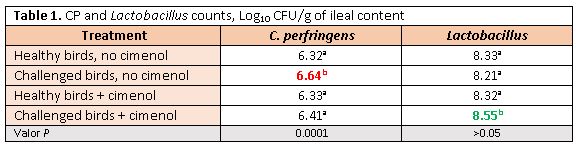
The microbiological analysis of the intestinal content showed that, in birds challenged with CP but no cimenol, the multiplication of the pathogen could not be controlled, and it obtained the highest counts (in red). Otherwise, the birds supplemented with cimenol ring obtained significantly lower counts because the molecule could control CP overgrowth.
b) Field trial in pigs
In a trial with 60 30-day-old weaned piglets were distributed into two groups, one fed a standard diet and the second with the same diet supplemented with cimenol ring and citric acid continuously. Escherichia coli (pathogenic) and Lactibacillus (non-pathogenic) counts were evaluated on day 60 of age.
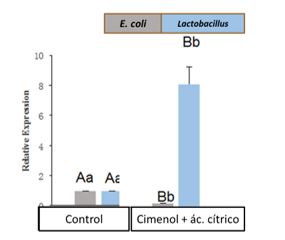
Results showed that cimenol ring reduced E. coli counts markedly at an intestinal level, as it obtained the lowest counts. On the contrary, it obtained the significantly higher Lactobacillus counts than the control, which proves that the additive has no effect on this beneficial microorganism.
Conclusions
The synergistic activity of the cimenol ring with citric acid is selective for pathogenic microorganisms like C. perfringens and E. coli. This selective efficacy was observed in several field trials conducted in broilers and pigs by evaluating the gut flora of animals receiving these supplements in their diets. Results showed that the combination can reduce the presence of pathogenic bacteria and that it does not affect the growth of beneficial microorganisms, which are actually favored by the elimination of their competitors.
The selective effect makes cimenol ring an ideal natural molecule to maintain the balance of the gut microflora and, therefore, intestinal welfare. Thus, its addition to feed and/or water reduces the prevalence of gut disorders and has a positive impact on performance parameters such as growth and feed conversion.
The synergistic activity base don cimenol ring and citric acid is available under the name Alquermold® Natural, an additive developed and marketed by Biovet, S.A. Premix and liquid presentations are available. Certified for organic production.





Leave a Reply
You must be logged in to post a comment.