


Effect of pronutrients in laying hens with low performance
Egg production is directly related to the status of the digestive system of hens. A good state of the intestinal mucosa will allow:1. An improvement in the general condition of the animal 2. A better defense against any type of digestive challenge 3.A correct absorption of the nutrients in the diet and a greater supply for egg formation.
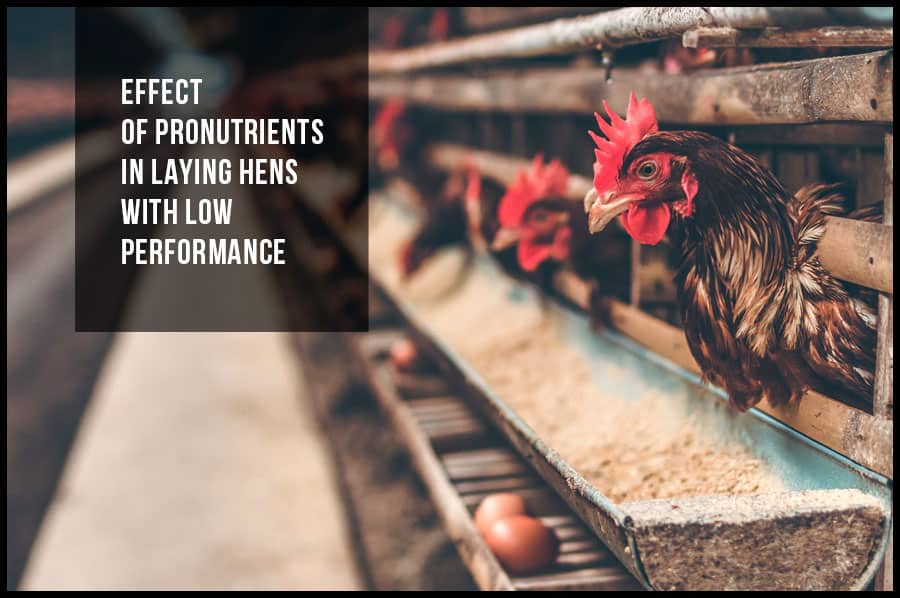
Egg production is directly related to the status of the digestive system of hens. A good state of the intestinal mucosa will allow:
- An improvement in the general condition of the animal.
- A better defense against any type of digestive challenge.
- A correct absorption of the nutrients in the diet and a greater supply for egg formation.
Introduction
A trial was carried out in a farm with low yield at the beginning of laying period, where there was a suspicion of a bacterial challenge affecting egg production.
This trial evaluated the effect of intestinal conditioner pronutrients to improve intestinal welfare and the productive parameters of the farm.
Experimental Design
Animals in the trial were 12,811 Hy-Line Brown laying hens, used as treatment group, which were compared with the standard parameters of the breed.
Animals were 25 weeks-old at the beginning of the trial and received 0.5 kg/t of intestinal conditioner pronutrients (ICP) continuously until the end of the cycle.
Results
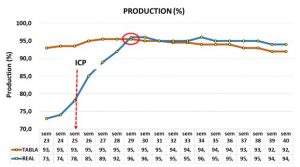
The initial production of the treatment batch was much lower than the standard set by the breed (-21.5%), as it can be seen in graph 1.
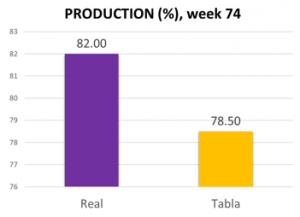
Since the start of the use of intestinal conditioner pronutrients (ICP), a gradual and progressive increase in the laying rate of the treated flock was observed. At 29 weeks of age, treated group was able to exceed the reference parameters of the breed, and maintained a higher rate throughout the rest of the cycle. At week 74 of the cycle (graph 2), the laying rate of the treated batch was of 82%, above the 78.50% set by the breed standard .
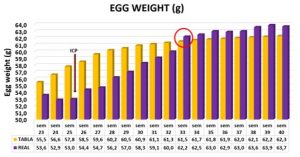
Similarly, egg weight (graph 3) was lower prior to the use of ICP (-3.5%) and, thanks to the treatment, there was a gradual increase in egg weight, which allowed the egg weight to exceed the standard established by the breed at week 34, and remain higher (+1.5-3%) the rest of the cycle.
Conclusions
The use of intestinal conditioner pronutrients (ICP) allowed to improve egg production by 2.2% and 4.5% in weeks 40 and 74, respectively, compared to breed standards. In turn, ICP improved the quality of the egg, increasing the egg weight by 1.5-3%, as well as the eggshell quality and the pigmentation of the yolk.
These results show the positive impact of intestinal conditioner pronutrients (ICP) on improving digestion and absorption of nutrients, egg production and egg quality.
By improving the general status of birds and their intestinal integrity, the risk of any digestive infectious challenge is reduced.
Additional advantages of pronutrients include they are a natural plant-based solution, which do not generate resistances and can be used continuously without withdrawal period, since they do not leave residues in meat nor eggs.
NOTE: During this cycle, no compatible signs with G. anatis were observed in a farm with a high prevalence in previous cycles.
Intestinal conditioner pronutrients are marketed by Biovet S.A. under the name “Alquernat Nebsui”.







Leave a Reply
You must be logged in to post a comment.